
Orchestra Cities is an open platform for cities to develop and share Smart City services. It is a data and IoT-driven solution that enables municipalities to effectively and collaboratively develop, share and monitor services in an open and collaborative way. Source code is open source, APIs are based on open standards, and mechanisms to import and integrate data and services are open, as well as shared and co-created data models.
2018
Orchestra Cities was born
Successfully tested in Antwerp (Belgium) and Helsinki (Finland)
Being Trialled in Germany and Switzerland
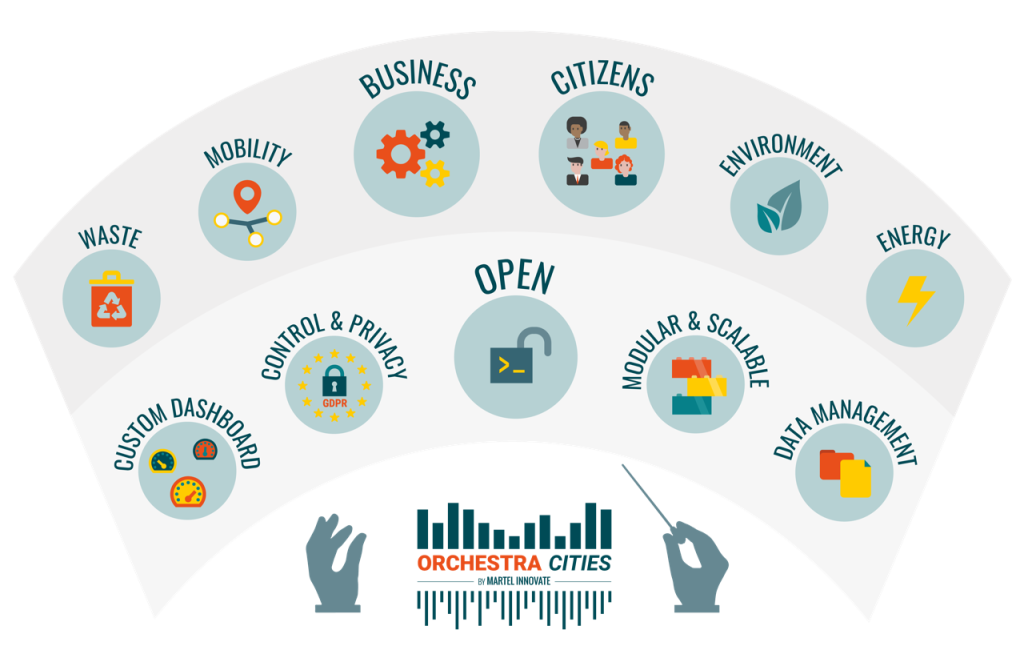
Features
- Security Management: the core of the security management is based on OIDC and OAUTH 2.0 standards. The solution supports Identity, Access and Organisation Management
- Device Management: to manage the IoT devices, Orchestra Cities leverages FIWARE stack and hence the NGSIv2 API and data format. FIWARE offers a wide range of so called IoT Agents. Each IoT Agent enables different transport and message protocols to be used to connect IoT Devices
- Data Management: the core of the data management is a “data bus” collecting data from the different sources and forwarding them to the different backend APIs based on the specific scenarios
- Dashboard Management: to allow the creation of custom dashboards, we use an open-source dashboard engine called Grafana, an open platform for beautiful analytics and monitoring
- Third Party Data Integration Management: to integrate external services and data sources, Orchestra Cities currently leverages StreamSets Data Collector. This tool allows the creation of pipelines for data harmonization and injection into the platform. Pipelines can be live tested, thus simplifying their development
Benefits
The concept of vertical data silos refers to data stored in different not interoperable platforms (e.g. waste management, parking management)
Support the migration from vertical data silos to a unified data space for a single integrated view over the city
A collaborative space where different cities can share data and services, while retaining control on their own data
Modular and flexible approach where each city can acquire just the needed services and resource quotas
Reduced ownerships costs thanks to the possibility of sharing the platform among different cities
Leverage Open Standards and Open Source code, thus building on the work of a large European and global community
Allow citizens and businesses to take part on the city services co-creation process
To know more about Orchestra Cities, please visit the new website!
Source code is open source, APIs are based on open standards, and mechanisms to import and integrate data and services are open, as well as shared and co-created data models.
Launched in 2018, Orchestra Cities was developed and tested with the municipalities of Antwerp (Belgium) and Helsinki (Finland) and is now being trialled in Germany and in Switzerland.